
What is the Consequence of Taking a Coverdell ESA “Nonqualified” Distribution?

By Mike Rahn, CISP
What are Coverdell ESAs?
The Coverdell Education Savings Account (ESA) began life in 1997 as the Education IRA. It was created on the Traditional IRA model, but intended to assist in accumulating financial resources for post-secondary education, rather than retirement.
It has since been modified both in name and in purpose. In 2002 the Education IRA was renamed the Coverdell education savings account, or ESA, following the death in 2000 at age 61 of its chief proponent, Sen. Paul Coverdell, (R) Georgia. Its purpose has since been expanded to also include saving for certain primary and secondary school expenses.
How do Coverdell ESAs compare to 529 Plans?
Despite the fact that ESAs were expanded in purpose, they have largely been supplanted by state and education institution-sponsored “529 plans”. This is due largely to the 529 plan’s more generous contribution limits, which allow for greater education savings over time. By contrast, the Coverdell ESA annual contribution limit has remained at its initial $2,000 amount, and has not been indexed for inflation, as have IRA and many other tax-qualified saving limits. Furthermore, up to $35,000 of 529 plan assets can be rolled over to a Roth IRA if certain conditions are met, a privilege not granted to ESAs. Similar to 529 plan contributions, ESA contributions do not qualify for a federal tax deduction, but earnings accrue tax deferred.
Nonetheless, there are many Coverdell ESAs in existence whose balances will eventually be used either for education expenses, or distributed to an account beneficiary—the intended “student”—for purposes other than education. Importantly, at age 30, such accounts are required to be distributed to the account beneficiary. It is unclear the extent to which ESA custodians adhere to this requirement.
Are ESA distributions taxable?
A. If ESA distributions are used timely to offset qualified education expenses there are no tax consequences. If they do not offset qualified expenses, the earnings are subject to tax and a 10 percent penalty tax. Distributions of contributory assets, or basis, are not subject to tax or penalty. While an ESA is open, distributions consist of pro rata portions of basis and earnings.
What are qualified education expenses?
Qualified education expenses include the following.
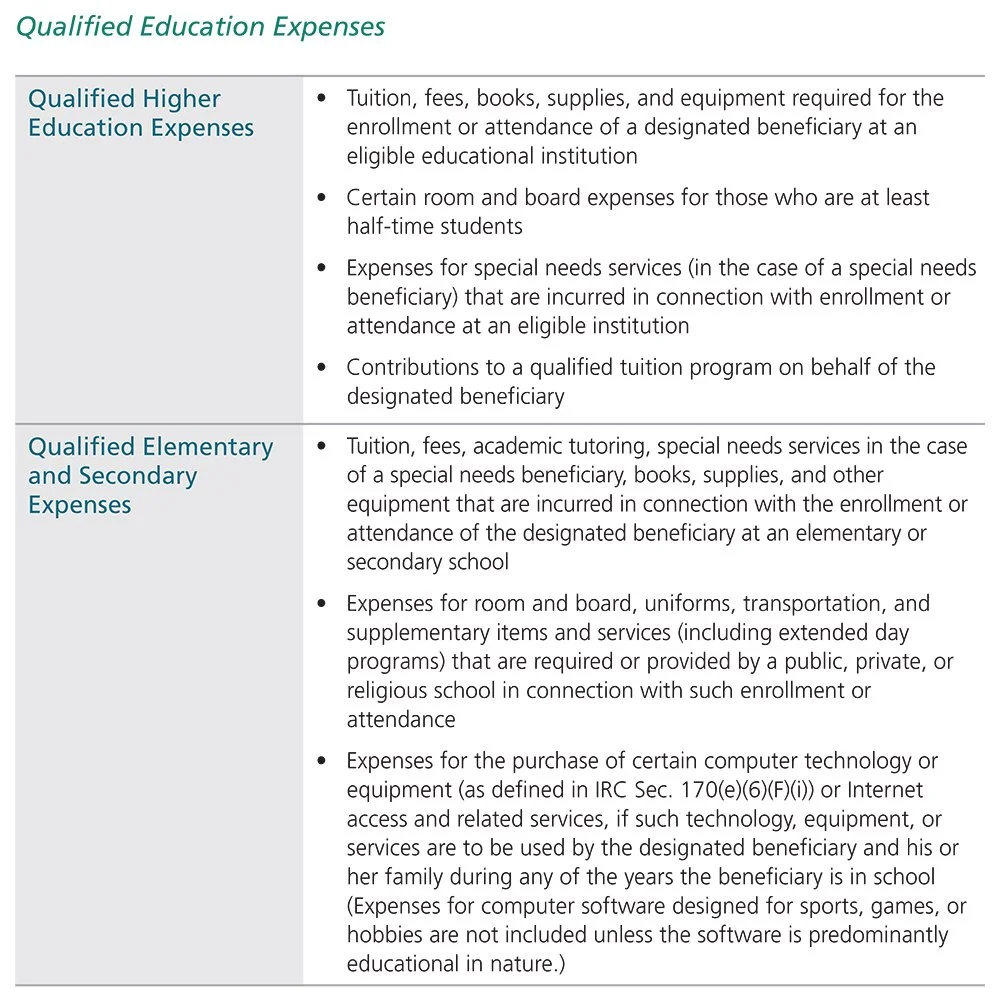
Distributions for any other purpose are considered nonqualified distributions.
Are there penalty tax exceptions?
While there is no escaping taxation of earnings in nonqualified ESA distributions, there are exceptions to the imposition of the 10 percent penalty tax. These exceptions include the following.
• Death
• Disability
• Designated beneficiary received a scholarship or certain other types of educational assistance
• (defined in IRS Publication 970)
• Distribution made for attendance at a U.S. military academy (within the allowable limits)
• Distribution taken into account in determining an American Opportunity or Lifetime
• Learning tax credit for the same year
Excess removed before June 1 of the year following the year for which the excess contribution was made
How are ESA distributions reported?
A. ESA distributions are reported on IRS Form 1099-Q, Payments from Qualified Education Programs, filed by the custodial organization that issued the distribution(s). A taxpayer reports any taxable earnings on Form 1040, U.S. Individual Income Tax Return. If a 10 percent penalty tax is owed on earnings it is paid with IRS Form 5329, Additional Taxes on Qualified Plans (Including IRAs)and Other Tax-Favored Accounts.
Takeaways
Coverdell ESAs have become less prominent among tax-qualified savings arrangements. Anecdotal evidence suggests that few new ESAs are being opened, for the aforementioned reasons. Nevertheless, for those who have an ESA account balance, the issues of potential taxation and possible tax penalties are real. For them, being aware of the rules will remain important.

