
Saver’s Match Brings New Government Contribution for Retirement Savers


By Mike Rahn, CISP
There is a long-held belief among U.S. policymakers that many Americans are saving too little to help ensure a financially secure retirement. Over the years, Congress has provided options and incentives to save more, the latest of which is the Saver’s Match, a provision in the SECURE 2.0 Act of 2022, available starting in 2027. On August 7, 2026, the IRS issued Notice 2026-48, announcing that the Department of the Treasury and the IRS intend to issue proposed regulations and describing the rules they expect those regulations to include. The Notice also requested public comments on several implementation issues.
Resembles Employer Matching Contributions
The Saver’s Match resembles employer matching contributions offered in 401(k) and SIMPLE IRA plans, but it is a federal matching contribution for eligible individuals with low or moderate incomes. Eligible individuals who contribute to an IRA or make elective deferrals to certain employer-sponsored retirement plans may receive a federal matching contribution of up to 50% of their qualified retirement savings contributions. Contributions of up to $2,000 may qualify, resulting in a maximum Saver’s Match of $1,000 per individual for the taxable year. Contributions made to a retirement account by an employer or government entity do not qualify as an individual’s qualified retirement savings contribution.
Qualified retirement savings contributions include eligible contributions to Traditional and Roth IRAs, elective deferrals to plans such as 401(k), SIMPLE 401(k), 403(b), governmental 457(b), SIMPLE IRA, and SEP arrangements, voluntary after-tax contributions to qualifying plans, and contributions to 501(c)(18) plans.
The types of arrangements that may receive Saver’s Match contributions are not identical to the arrangements to which an individual may make a qualified savings contribution. Saver’s Match contributions may be deposited into a SEP, SIMPLE, or Traditional IRA or to the pretax deferral account of a 401(k), 403(b), or governmental 457(b) plan.
Except for IRAs, contributions must be made by the end of the tax year for which the match is sought. IRA contributions made during the January-to-April “carryback” period may qualify for a match attributed to the prior year, if the contribution is timely made and designated for that prior year.
Saver’s Match contributions are not included in an eligible individual’s gross income when contributed to an applicable retirement savings vehicle. Distributions attributable to Saver’s Match contributions are subject to income tax when distributed, unless rolled or transferred to another retirement plan or IRA. For taxpayers who want the match deposited into a Roth IRA, Treasury and the IRS are considering a process in which the Treasury Department would first deposit the Saver’s Match into a conduit Traditional IRA, and then immediately move it to a Roth IRA through a Roth conversion. No guidance on how this election will be made is currently available.
The $2,000 annual contribution amount potentially eligible for a Saver’s Match is not indexed for inflation, and would require Congressional action to increase. The taxpayer income ranges that determine match eligibility will be subject to annual cost-of-living adjustments for taxable years after 2027.
Match Replaces Saver’s Credit
The Saver’s Match is a replacement for the Saver’s Credit for qualified retirement savings contributions, which was created in 2001 by the Economic Growth and Tax Relief Reconciliation Act of 2001 (EGTRRA). The Saver’s Credit was available to qualifying individuals who made contributions to an IRA or an employer retirement plan. It was not refundable, however, so individuals who did not have an income tax obligation equal to—or greater than—their Saver’s Credit did not receive its full benefit. The Saver’s Match differs from the nonrefundable Saver’s Credit because an eligible individual may receive the match even if the individual has little or no federal income tax liability for the year.
During the transition from Saver’s Credit to Saver’s Match, retirement contributions made to an IRA during the January 1 through April 15, 2027, period may qualify for the credit if made as a carryback contribution for 2026, or for the match if made for the 2027 tax year. The Saver’s Credit will remain available after 2026 for contributions to ABLE accounts.
If an individual’s Saver’s Match amount for a taxable year is less than $100, the individual may elect to receive the amount as a refundable tax credit instead of having it contributed to a retirement savings vehicle. For a married couple filing jointly, the election and the $100 threshold apply separately to each spouse.
Basic Saver’s Match Requirements
To qualify for the Saver’s Match, an individual must meet the following requirements.
Be 18 years of age by the end of the tax year
Not be claimed as a dependent on another taxpayer’s income tax return
Not be a student as defined in Internal Revenue Code Section 152(f)(2)
Be a U.S. resident for tax purposes (nonresidents generally do not qualify)
File a U.S. federal income tax return to claim the match
Meet income requirements
Make an eligible contribution to an IRA or employer-sponsored retirement plan (no minimum)
Filing Status and Income Determine Eligibility
An individual’s filing status and Saver’s Match modified adjusted gross income (MAGI) determine whether the individual is eligible, and, if eligible, the applicable matching percentage.
Step One: Filing Status
Unlike the Saver’s Credit, which has four fixed, income-based tax credit tiers (0%, 10%, 20% and 50%), the Saver’s Match uses a maximum 50% match that declines within a phaseout range based on the individual’s filing status and Saver’s Match MAGI.
Step Two: Income
The definition of MAGI for Saver’s Match eligibility is not identical to the MAGI definitions used for Traditional and Roth IRA contributions. Saver’s Match MAGI begins with adjusted gross income (AGI) from IRS Form 1040, U.S. Individual Income Tax Return, to which are added back the following items.
Deductible Traditional IRA contributions
Pretax elective deferrals and other salary reduction retirement contributions
Certain excluded foreign and territorial income
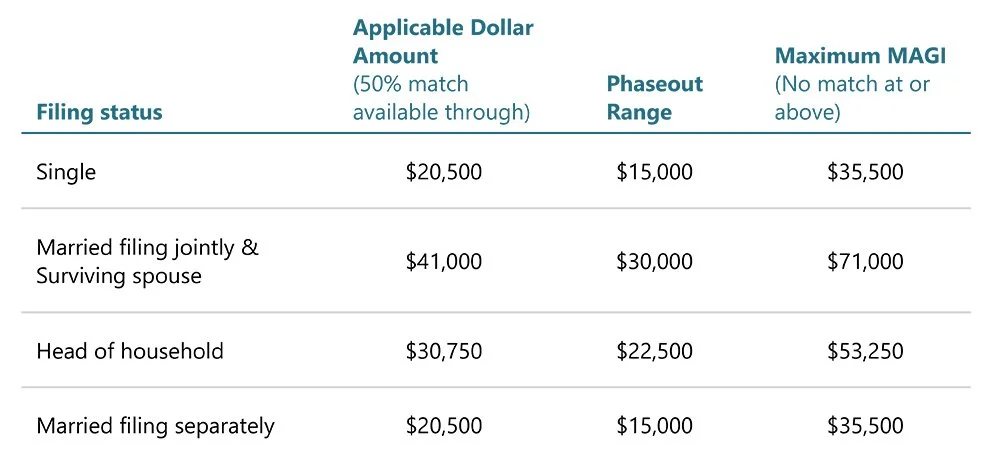
Once MAGI is determined, the table below is used to calculate the applicable Saver’s Match percentage. For each tax filing status, MAGI at or below the lower income threshold qualifies the taxpayer for a maximum Saver’s Match (50% of contributions up to $2,000). MAGI between the lower- and upper- income limits qualifies for a prorated Saver’s Match.
Example: Single Filer Calculation
Mary, age 23, is a single filer. In 2027 she made a $1,600 Traditional IRA contribution. Her 2027 MAGI is $28,100. She is below the maximum MAGI limit to receive the match and is above the $20,500 applicable dollar amount. Therefore, she falls within the $15,000 phaseout range.
Percentage point reduction: 50 x (MAGI – applicable dollar amount) ÷ phase out range
50 x (($28,100 - $20,500) ÷ $15,000) = 25.3333Rounded down reduction: Round the percentage point reduction down to the next lowest whole number
25%Applicable percentage: 50% - Percentage point reduction
50% - 25% = 25%Saver’s Match: Contribution amount x applicable percentage
$1,600 x 25% = $400
Guardrails to Prevent “Gaming”
To prevent the recycling of existing retirement savings in order to claim a new Saver’s Match, certain distributions from an IRA or employer plan during a “testing period” reduce an individual’s qualified retirement savings contributions. The testing period includes the taxable year for which the Saver’s match is claimed, the two preceding taxable years, and the period after the end of the claim year through the due date, including extensions, for filing the individual’s federal income tax return for that year. Certain distributions received by the spouse of a taxpayer seeking the match will have the same effect.
Match Mechanism Still Under Development
Qualifying retirement plan contributions do not automatically generate a government matching contribution. Under Notice 2026-48, an eligible individual would claim the Saver’s Match by filing a federal income tax return and a separate Form 8880-A. The Treasury Department is still determining how matching contributions will be delivered to the IRA or retirement plan chosen by a match-eligible taxpayer.
Under current guidance, participation by plan sponsors and IRA trustees/custodians is optional. Such entities will not be required to accept Saver’s Match contributions on behalf of plan participants and IRA owners.
Registration and Amendment Requirements
Notice 2026-48 describes several potential processes under which an employer-sponsored retirement plan, recordkeeper, service provider, or IRA trustee/custodian may register with Treasury or provide information needed to facilitate payment of Saver’s Match contributions. The registration and payment requirements will depend on the approach ultimately adopted in future guidance.
Retirement plans that accept direct Saver’s Match contributions must adopt a discretionary amendment permitting the contributions. The plan may later be amended to stop accepting Saver’s Match contributions without violating anti-cutback rules.
For IRAs, Treasury is considering a registration-based process where participating organizations would obtain IRA tracking numbers that taxpayers could report on Form 8880-A.
Although Notice 2026-48 does not require an IRA document amendment, an IRA disclosure statement must reflect applicable law at the time the IRA is opened. Therefore, financial organizations should evaluate whether to update their disclosure statements to address the Saver’s Match.
Other Considerations
General retirement plan contribution limit and nondiscrimination testing are not affected by a retirement plan’s acceptance of Saver’s Match contributions on behalf of participants.
Pre-59½ withdrawals of amounts attributable to the Saver’s Match may trigger a “recovery tax,” based on match amounts relative to the remaining account balance, calculated by an IRS formula and offsets.
Saver’s Match contribution amounts are not available for hardship or unforeseeable emergency distributions, but earnings thereon can be. Saver’s Match amounts are also available for certain special-purpose distributions, such as disaster recovery.
Saver’s Match contributions for retirement plan participants will be reported in aggregate with Form 5500-series retirement plan annual return filings, and individually for IRAs on Form 5498, IRA Contribution Information.
Saver’s Match contributions are generally treated as elective deferrals for such purposes as determining plan loan availability, entitlement to a direct rollover, plan cash-out determinations, RMDs, joint-and-survivor annuity rules, and in-plan Roth rollovers.
Erroneous Saver’s Match contributions—those paid to an ineligible individual or account, or improperly calculated—are treated as an underpayment of tax. If removed by the tax filing due date, including extensions, they are not subject to the 10 percent early distribution penalty tax. Earnings attributable to the erroneous contribution need not be removed; but if they are removed, they are taxable. The IRS is considering a special Form 1099-R reporting code for this situation.
The IRS has provided safe harbor notice language that can be used by plan sponsors to alert participants to the opportunity to contribute to their employer’s plan and potentially claim a saver’s match contribution.
What’s Next?
The Saver’s Match represents a significant change in the federal retirement savings incentive for individuals with low or moderate incomes. Rather than reducing a taxpayer’s federal income tax liability, the program generally will direct the benefit into a designated retirement savings vehicle.
Notice 2026-48 is an important step toward implementation, but significant operational details remain under development. Treasury and the IRS have announced their intent to issue proposed regulations addressing the Saver’s Match rules concerning claiming, registration, payment routing, reporting, corrections, and other administrative requirements.

